Eastern Tent Caterpillars in Nashville
Eastern tent caterpillars emerge every spring across Davidson County, building silken tents in cherry, crabapple, and apple trees. Repeated infestations weaken trees and invite secondary disease, but timely intervention protects your trees.
Every spring, as Nashville’s trees push their first buds, eastern tent caterpillars begin building the silken tents that alarm homeowners across Davidson County. These insects are one of the most visible tree pests our crews encounter each season, particularly on the north and east sides of the city. Understanding what you are dealing with, and how to respond, goes a long way toward keeping your trees healthy for years to come.
What Are Eastern Tent Caterpillars?
Eastern tent caterpillars (Malacosoma americanum) are native insects that complete one generation per year. They strongly prefer wild cherry, apple, and crabapple trees, though they will occasionally feed on other members of the rose family, including hawthorn, plum, and pear.
The life cycle follows a predictable pattern:
- Egg masses overwinter on small twigs, appearing as shiny, dark bands wrapped around the branch. A single mass contains 150 to 400 eggs.
- Hatching happens around bud break, typically in early March in Nashville, timed precisely to when new foliage becomes available.
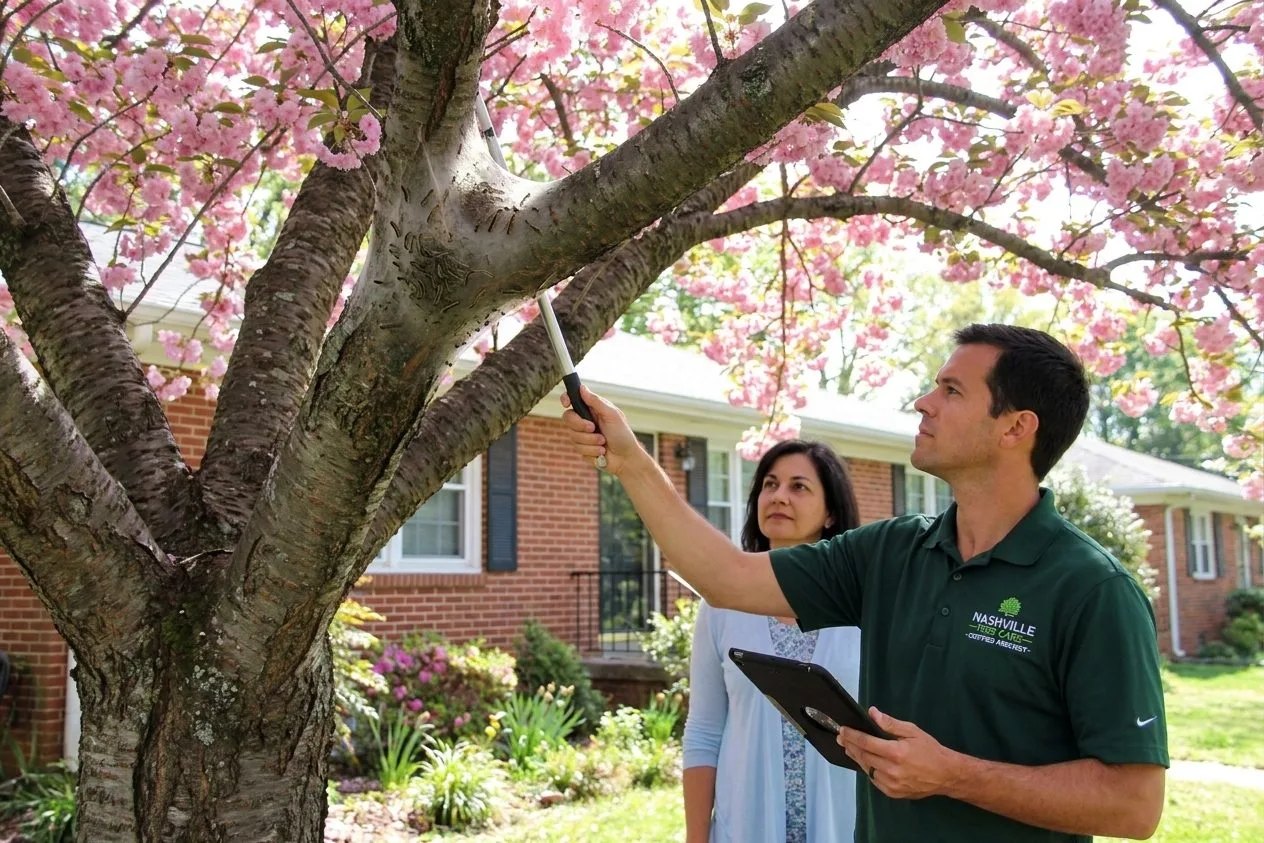
- Tents form in the branch crotches (forks) where caterpillars congregate to warm up and digest food. The tent grows larger as the colony grows.
- Feeding continues through April and into May. Caterpillars leave the tent daily to feed on leaves, returning at night or during rain.
- Pupation occurs in late spring. Adults emerge, mate, and lay the next season’s egg masses before summer.
How to Identify an Infestation
The silken tents are the most obvious sign, but a close look at your tree reveals more:
- White or gray silken tents, typically a few inches across early in the season and growing larger through April
- Stripped or skeletonized leaves near the tent, progressing outward as the colony expands
- Dark, shiny egg masses on pencil-sized twigs in fall and winter, the best time to spot and remove them before hatch
- Black caterpillars with a white stripe running down the back, bordered by blue spots and reddish-brown and yellow lateral markings, roughly two inches long at maturity
Our crews see this consistently in East Nashville, Inglewood, Madison, Donelson, Hermitage, Goodlettsville, and Hendersonville, where mature ornamental cherries and crabapples are common in older residential neighborhoods.
Why This Matters for Nashville Trees
A single year of tent caterpillar infestation rarely kills a healthy tree. Nashville’s clay-heavy soils and warm, humid summers already place trees under some stress, and spring storms and occasional late ice events compound that. When caterpillars strip a tree of its leaves right at bud break, the tree is forced to spend stored energy pushing a second flush of growth. Do that two or three years running and the picture changes.
Repeated defoliation:
- Depletes the tree’s energy reserves, reducing its ability to fight off disease and other insects
- Opens wounds and weakens bark, making the tree more susceptible to borers like the lesser peach tree borer, which targets stressed cherries
- Can contribute to branch dieback in already stressed trees
An ornamental cherry in a Donelson backyard that defoliates every April for three consecutive seasons may begin to show crown thinning and premature decline by the time a homeowner calls us.
What to Do: Treatment and Removal Options
The best time to act is before the eggs hatch or in the earliest stage of colony formation.
Winter Scouting and Egg Mass Removal
From November through February, walk your property and look for egg masses on cherry and crabapple twigs. Removing egg masses by hand or pruning out infested twigs is one of the most effective and lowest impact controls available. No chemicals needed.
Mechanical Removal of Young Tents
When caught early, in March before the tent has grown large, a gloved hand or pruning tool can remove the tent and caterpillars directly. Opening the tent before applying any spray treatment also improves contact, since the silken structure shields caterpillars from some applications. Dispose of removed material away from the tree.
Biological and Targeted Treatments
For established colonies or trees that cannot be easily reached:
- Bacillus thuringiensis var. kurstaki (Bt) is a naturally occurring soil bacterium that kills caterpillars when ingested. It is effective, highly specific to caterpillars, and does not harm bees, birds, or most beneficial insects. It works best on young caterpillars shortly after hatch, so timing matters.
- Spinosad-based sprays are another lower-impact option that our arborists may recommend when Bt timing has passed, though spinosad can affect some beneficial insects and bees and should be applied with care.
- Dormant oil applied in late winter can smother overwintering egg masses, though thorough coverage of small twigs is required.
Broad-spectrum insecticides are generally not necessary and can harm the beneficial insects that help keep secondary pest populations in check.
Timing Is Everything in Nashville
In Middle Tennessee, the window between hatch and full colony establishment is roughly two to three weeks in March. Acting early, while caterpillars are small and the tent is still compact, produces the best results with the least intervention.
When to Call an Arborist
Call a professional when:
- The tree is large and treatment requires reaching the upper canopy
- You notice tent activity across multiple trees or recurring seasons
- The tree already shows signs of stress, crown thinning, or branch dieback
- You are unsure whether the pest is eastern tent caterpillar or fall webworm, a different species active in late summer and fall with different management timing
- You want an honest assessment of whether a heavily damaged tree is worth treating or poses a risk
Our credentialed arborists assess the whole tree, not just the pest. We look at species, structure, soil conditions, and the surrounding landscape before making any recommendation.
If you are seeing tents in your yard or want an evaluation ahead of next spring’s hatch, reach out for a free on-site assessment. We cover Davidson County and the surrounding communities and are glad to give you a straight answer about what your tree needs.
Worried about this on your Nashville property?
An expert arborist will assess it in person and give you a written plan. Free estimate, no pressure.